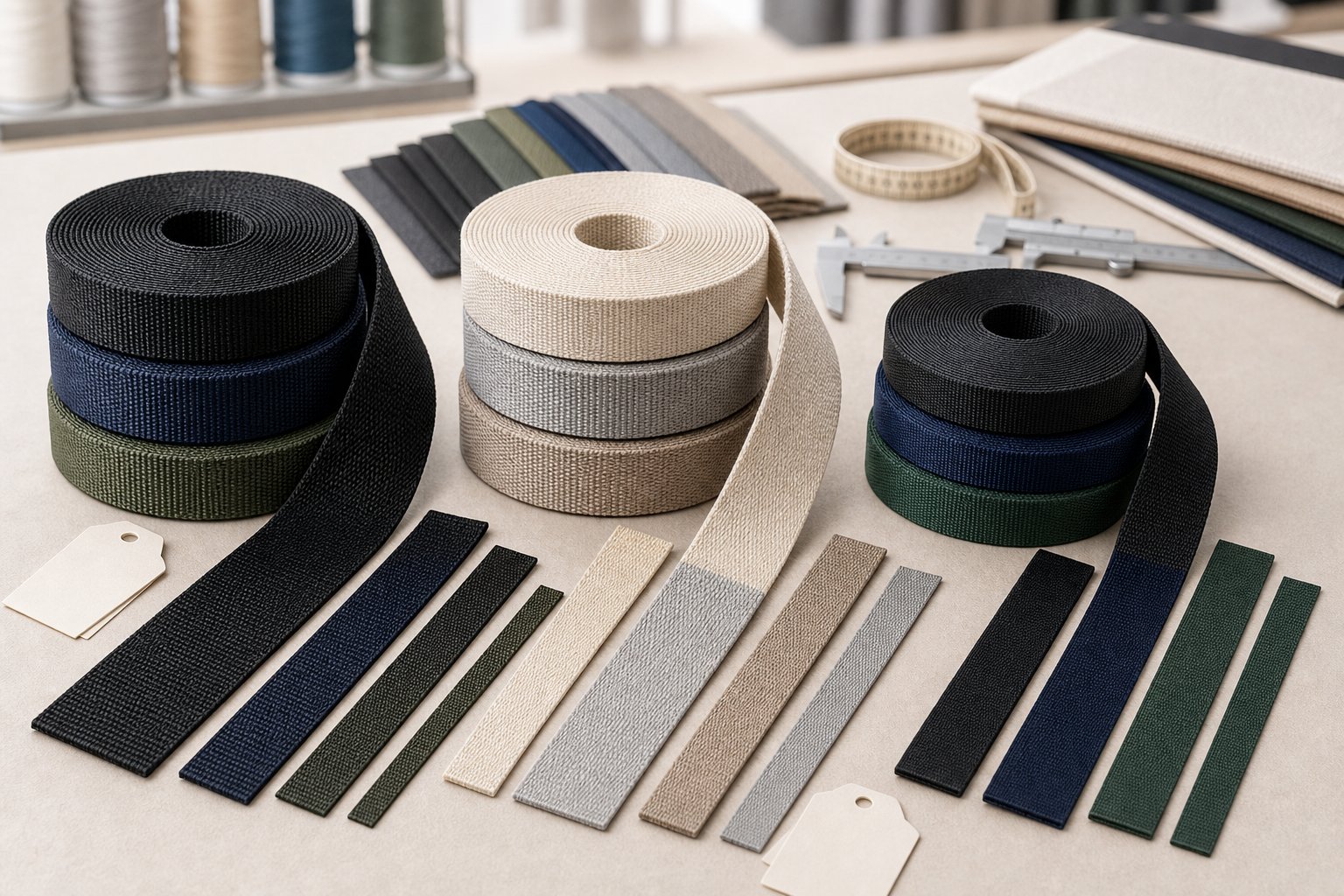
Material No need to guess the answer first
Nylon straps are often used in products that require wear resistance, a solid feel or a high sense of support, such as luggage straps, pet products, outdoor accessories and some fixed straps. It is easier to create a thick texture, but the actual performance still depends on the yarn, weave, thickness and finishing.
PP straps are commonly used in packaging straps, general fixing straps, lightweight accessories and cost-sensitive products. It is lightweight, has low water absorption, and its color and feel can be adjusted according to the purpose. If the product does not require a heavy touch, PP tape is often a pragmatic option.
Look at the product first, then the material
| Luggage straps and handles | We always pay attention to wear resistance, feel and hardware matching. You can first compare the feel and thickness after folding of nylon straps and thicker PP straps. |
|---|---|
| Pet collars and leashes | It is necessary to confirm the width, thickness, sewing strength, buckle sliding condition and feel, and avoid selecting materials based on color alone. |
| Outdoor straps and straps | It is necessary to provide the usage environment, force direction, buckle type and whether it has been exposed to the sun for a long time, and then evaluate the material and finishing. |
| Packaging and general strapping | If the focus is on lightweight, cost and high-volume availability, PP tape is usually easier to include in the comparison. |
| Finished accessories or decorative tapes | The focus is on color, texture, width and feel; if it needs to be close to the skin or cloth, you should also look at the softness and edge touch. |
What specifications do I need to provide when making an inquiry?
- Product uses: bags, pet supplies, outdoor accessories, packaging fixation or other product accessories.
- Dimensional conditions: width, thickness, length of each section, whether the whole roll is supplied.
- Appearance requirements: color, texture, surface feel, whether it needs to be compared with samples or color cards.
- Processing requirements: cutting, heat cutting, sewing, punching, folding, fastener assembly or bagging.
- Functional focus: wear resistance, tensile strength, softness, light weight, cost or cooperation with buckles.
- Mass production information: estimated quantity, delivery date, whether sampling is required first.
When sampling, put it directly into the product situation.
The most common gap when comparing materials is that the sample may feel OK to the touch, but it may not be suitable after being fastened or sewn. When making samples, it is best to directly test the fasteners, sewing methods and cutting lengths that are close to mass production, and then check the folding thickness, edge feel, sliding conditions and appearance after stress.
If you already have samples, you can send them or provide close-up photos, dimensions and usage scenarios; when you are still figuring out the direction of a new product, first talk about its purpose, budget, appearance requirements and stress mode, and you can quickly narrow down the material direction.
Nylon straps and PP straps are not absolutely good or bad. The real comparison is whether the use, specifications, fasteners and finishing are compatible; if the photos of the product, fasteners, width and force mode are provided together, the judgment will be much more accurate.
Send material inquiryFAQ
I don’t know whether to choose nylon belt or PP webbing, can I inquire directly?
Can. Please provide the purpose, width, thickness, color, quantity, whether sewing or fastener assembly is required, and photos of existing samples, and then use the product condition to judge the material.
Can nylon straps and PP straps use the same buckle?
Not always. Buckle fit depends on webbing width, thickness, surface friction, fold method, and force direction. Please provide photos of the buckle or the product to avoid slipping or getting stuck after mass production.