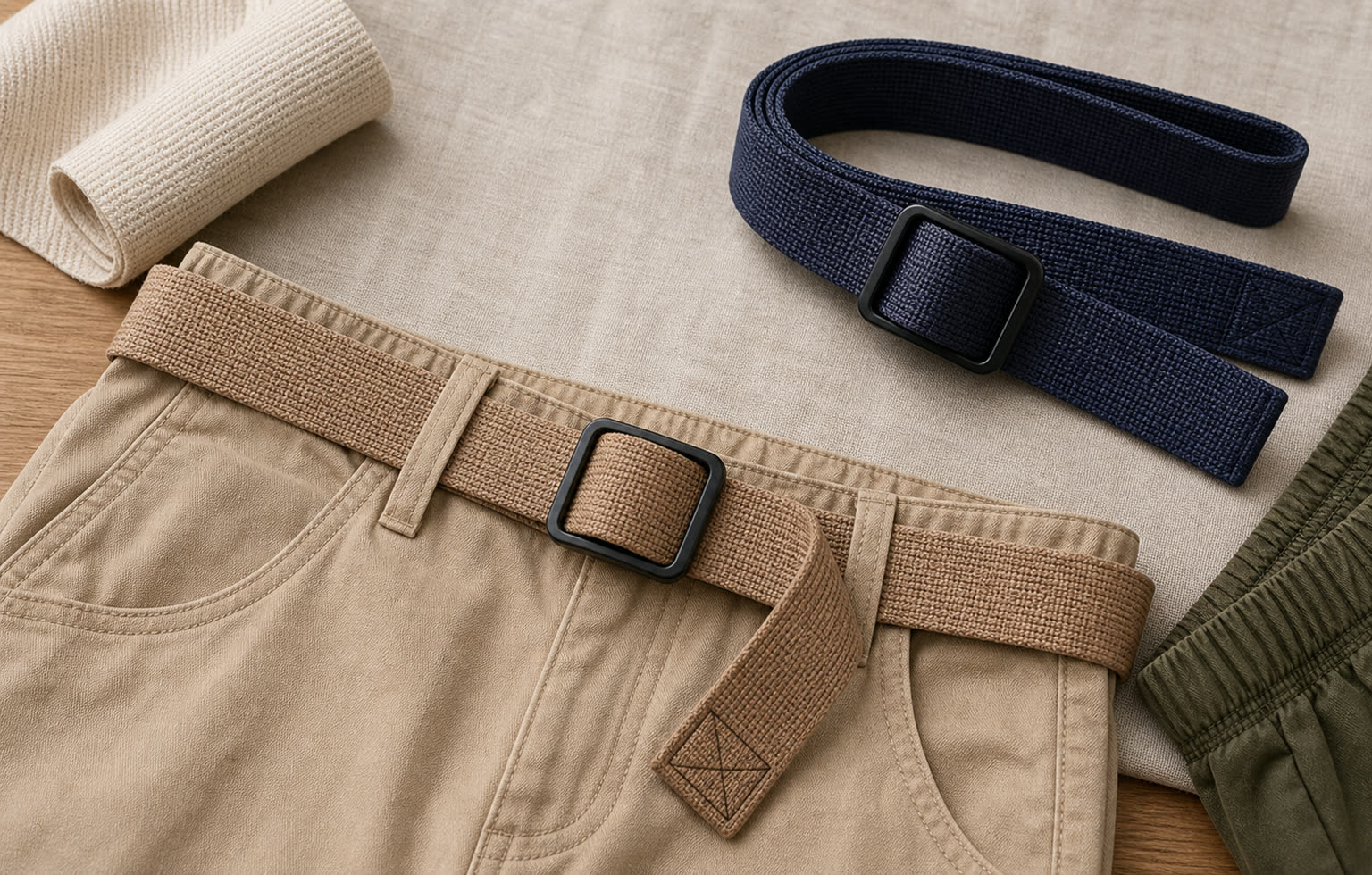
Common uses of textile belts
Common applications include casual belts, work pants adjustment straps, coat straps, apron straps, clothing decorative straps and bag adjustment straps. The emphasis is different for different uses: some look at appearance stiffness, some look at smooth adjustment, and some look at the feel of long-term contact with cloth or skin.
If the belt needs to be equipped with a plastic buckle, metal buckle, tri-glide buckle or plug buckle, please include the buckle in the specification discussion from the beginning. When the inner diameter of the buckle and the thickness of the webbing are inconsistent, the product will easily get stuck or loosen.
Stiffness, thickness and feel
| casual belt | It usually requires a more substantial thickness and stiffness, but also depends on the thickness of the buckle, the tail of the strap and the smoothness of the appearance. |
|---|---|
| Adjustable belt for work pants | Pay attention to tensile strength, wear resistance, smooth adjustment and sewing strength, and the color should usually match the fabric. |
| clothing decorative belt | The focus is on color, feel, width ratio and whether it is skin-friendly. Thicker is not necessarily better. |
The finishing of buckles and strap tails will determine the fineness of the product.
The tail of the belt is often cut, folded and sewn, wrapped, punched, rivets or metal ends. If you want to match the buckle, you also need to check whether the thickness after folding can be sewn, whether it will affect the belt wearing, and whether the edge of the buckle is easy to wear the belt surface.
- Plastic steel buckle: Light weight, common in casual and outdoor style accessories.
- Metal buckle: The texture is more obvious, but you need to pay attention to the weight, surface color and webbing thickness.
- tri-glide buckle and adjustment buckle: It is necessary to confirm the smooth sliding, anti-slip effect and webbing thickness.
- Tail finishing: It needs to be decided based on appearance positioning, cost and mass production process.
Color, stitching and packaging
Belt accessories are often directly seen by consumers, so the color, stitching and buckle color must be looked at together. If it is a brand color, it is recommended to provide a color card or sample; if the same style has multiple colors, you need to first confirm the quantity of each color, whether it is packaged in mixed colors, and whether barcodes or size markings are required.
Textile belt inquiry list
| Product type | Casual belts, work pants adjustment belts, clothing decorative belts, apron straps, bag adjustment belts. |
|---|---|
| Size | Width, thickness, product length, cutting length, tape tail length. |
| Material and feel | Nylon, PP, polyester, cotton feel, elastic or non-elastic, stiffness direction. |
| Fasteners and Finishing | Plastic steel buckle, metal buckle, tri-glide buckle, hot cutting, sewing, punching, toe cap or rivet. |
| Appearance and packaging | Color, sewing thread color, hardware, size indication, single bag or complete set packaging. |
If you already have a buckle or sample, please take photos of the buckle, strap tail, and sewing back. If you don’t have a sample yet, you can first provide the product’s purpose, expected width, color, and desired stiffness.
Send Textile Belt InquiryFAQ
Should the textile belt be harder or softer?
It depends on the positioning of the clothing and the structure of the buckle. Casual belts usually require a certain degree of stiffness, while work pants adjustment belts must take into account both tension and smooth adjustment, and attention must be paid to the feel of the close-fitting position.
Do belt buckles need to be provided together?
If you already have a fastener, it is recommended to provide the inner diameter, thickness, material and photos of the fastener; if it has not yet been determined, you can first provide the use and desired appearance of the product, and then evaluate the suitable fastener direction together.
What can be done with the tape tail?
Common methods include cutting, folding and sewing, toe wrapping, punching, rivets or metal ends. Actual requirements depend on appearance, durability, cost and mass production methods.